


faq what is the body paragraph

What is a Body Paragraph?

body paragraph meaning,how to write a body paragraph,essay components,paragraph organization,academic essay structure,analytical writing,topic sentences,evidence in writing,conclusion sentence paragraph,effective communication writing

Key highlights

body paragraph definition,essay structure,paragraph writing tips,topic sentence examples,supporting details,paragraph coherence,academic writing guide,developing arguments,featured snippet answer,humanized content

Frequently asked questions

  • What is the definition of a body paragraph?

    A body paragraph is a distinct section of an essay or report that presents and develops a single main idea supporting the overall thesis statement. It usually includes a topic sentence, supporting evidence, and analysis to elaborate on a specific point. This structured approach helps organize arguments clearly for the reader.

  • What elements must a body paragraph include?

    A complete body paragraph typically must include a clear topic sentence stating its main idea, specific supporting details or evidence, and a thorough analysis explaining how that evidence supports the topic. Often, it concludes with a summary or transitional sentence, ensuring a unified and coherent presentation of thought.

  • How long should a body paragraph be?

    There is no strict rule for body paragraph length; however, most effective paragraphs range from five to eight sentences. This length allows enough space to introduce a topic, provide sufficient evidence and explanation, and conclude the idea without becoming too short or excessively long and cumbersome for the reader to process easily.

  • Why are topic sentences crucial for paragraphs?

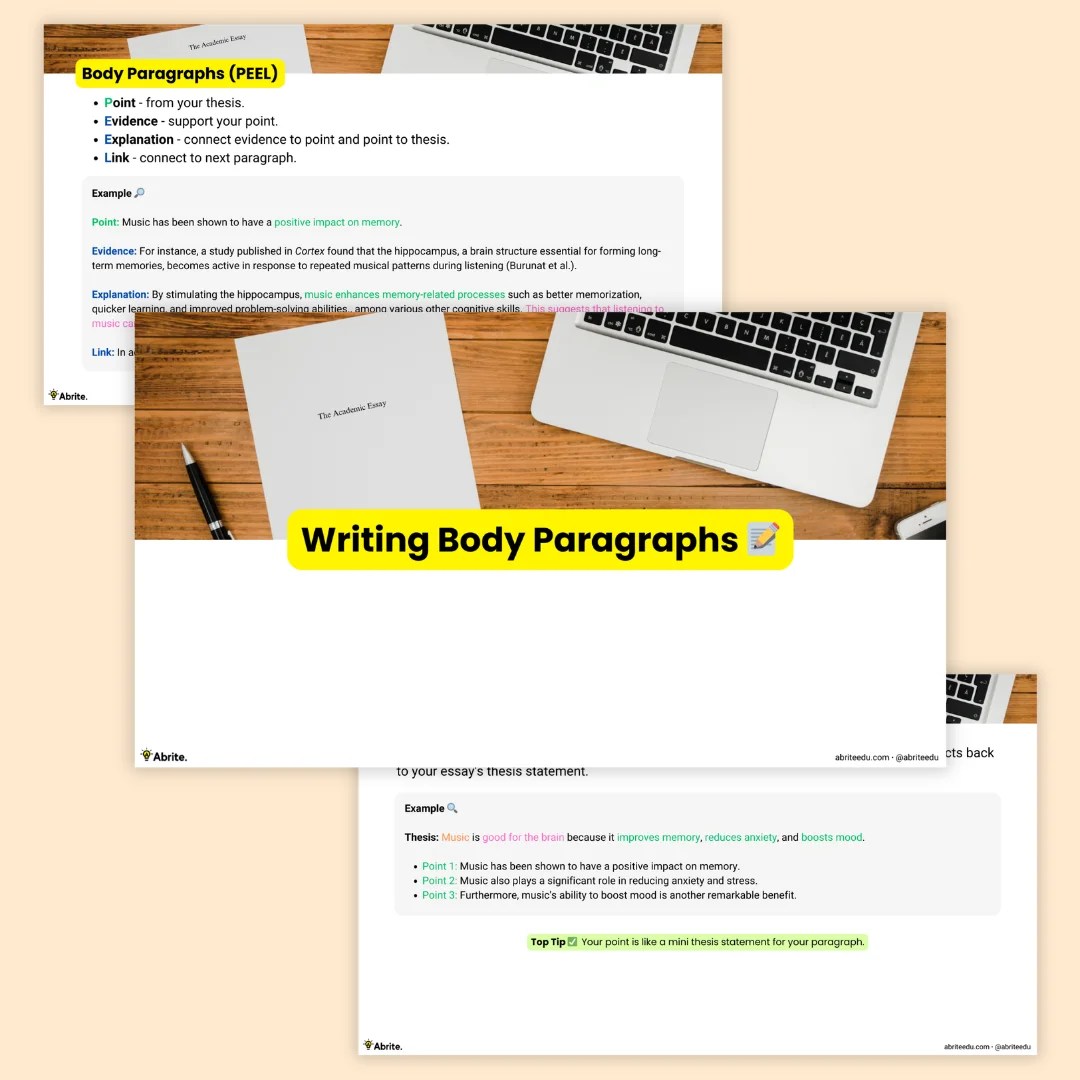
    Topic sentences are crucial because they clearly state the main idea of a paragraph, acting as a mini-thesis for that section. They guide the reader, setting expectations for the content to follow and directly linking the paragraph's idea back to the essay's overall thesis. This ensures focus and organizational clarity.

  • Can a body paragraph have multiple main ideas?

    No, a body paragraph should ideally focus on only one main idea to maintain unity and clarity. Introducing multiple main ideas within a single paragraph can confuse the reader and weaken the argument. Each distinct idea should typically be developed in its own separate body paragraph for optimal organization and impact.

  • What is the role of a concluding sentence in a paragraph?

    A concluding sentence in a body paragraph serves to summarize the main point discussed, reinforce its connection to the topic sentence and overall thesis, and sometimes provide a smooth transition to the next paragraph. It offers closure to the specific argument presented in that paragraph, ensuring a cohesive flow within the essay.

  • How do body paragraphs support the overall essay?

    Body paragraphs support the overall essay by individually developing and substantiating the various arguments or points that collectively prove the essay's central thesis. Each paragraph contributes a specific piece of evidence and analysis, building a comprehensive and well-reasoned case that leads the reader to accept the essay's main conclusion, making the entire argument robust.

Story

Understanding the Body Paragraph Core of Effective Writing

Every well structured essay or report hinges upon its body paragraphs. These individual sections are the very substance of your argument, serving to expand upon the thesis statement presented in your introduction. Think of each body paragraph as a miniature essay within the larger composition, each dedicated to exploring a single main idea or piece of supporting evidence that validates your overall point. This systematic approach allows readers to follow your reasoning clearly, making complex arguments accessible and convincing.

A robust body paragraph provides the essential details, explanations, and evidence required to support a specific claim. Without these carefully developed sections, an essay would lack depth, persuasiveness, and credibility. Each paragraph must function as a complete unit of thought, connecting back to the main argument while also transitioning smoothly to the next point. This careful balance ensures the entire piece flows logically, guiding the reader through your analysis step by step.

What exactly makes a paragraph effective in conveying its message? It involves more than just grouping sentences together. An effective body paragraph is a carefully constructed unit designed to inform, persuade, or explain, always contributing directly to the document's central thesis. Writers in the US academic and professional spheres prioritize clarity and directness within these foundational blocks of text, ensuring every word serves a purpose in advancing the main argument and engaging the reader.

What are the essential elements of a strong body paragraph?

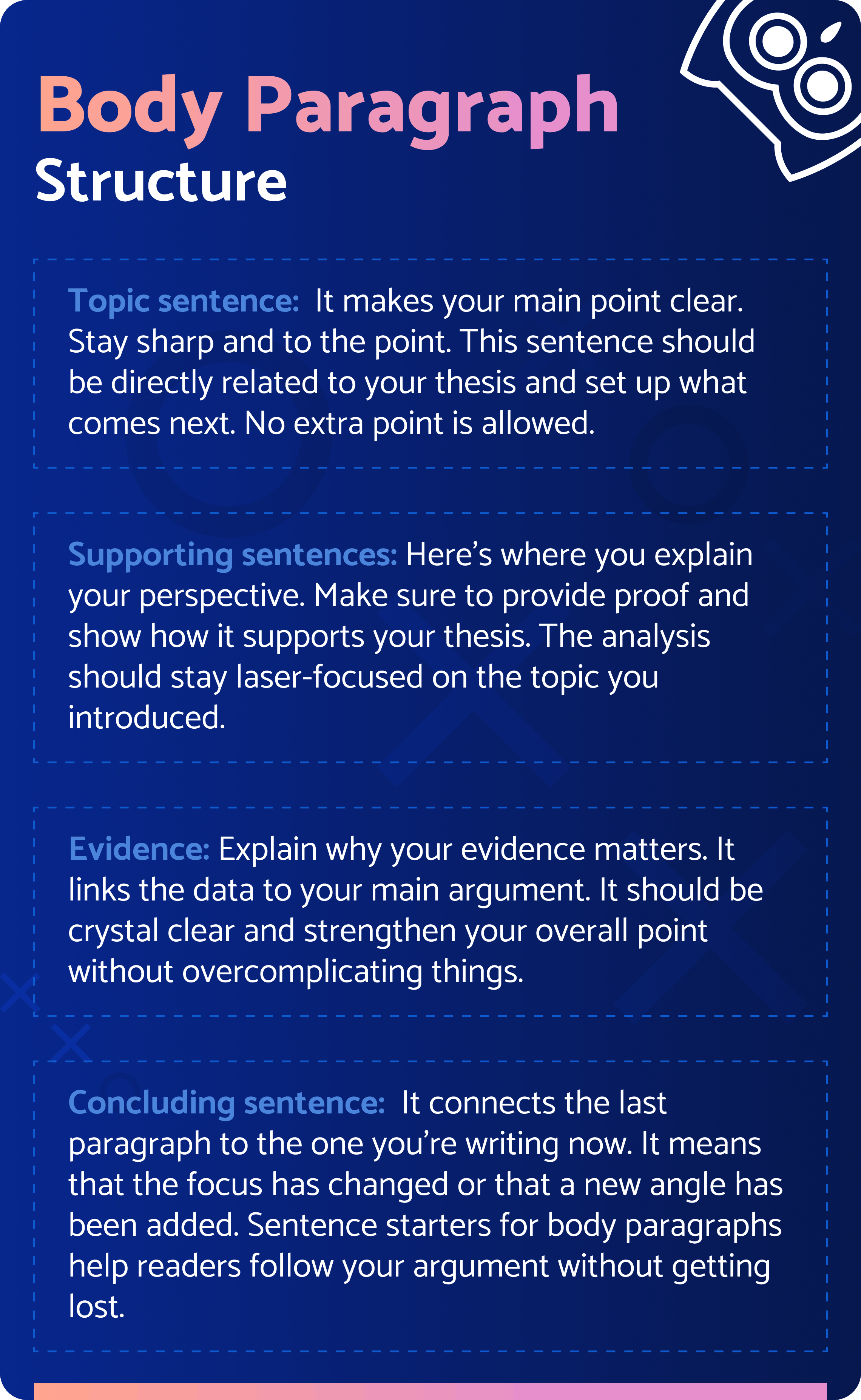
A strong body paragraph typically includes several core components that work in harmony to present a complete thought. It always begins with a clear topic sentence, which acts as a mini thesis for that particular paragraph, outlining the main idea it will explore. This initial statement sets expectations for the reader, indicating what specific aspect of the overarching argument will be discussed next. The topic sentence should be concise yet informative, directly linking back to the essay's main thesis.

Following the topic sentence, supporting details and evidence are crucial. These can take many forms: facts, statistics, examples, anecdotes, quotes from authoritative sources, or expert opinions. The purpose of these details is to substantiate the claim made in the topic sentence, providing concrete backing for your assertions. Writers must present this evidence clearly and logically, ensuring its relevance is immediately apparent to the reader. Strong evidence makes your argument more credible and persuasive.

Finally, a strong body paragraph concludes with an analysis or an explanation of how the presented evidence supports the topic sentence, and ultimately, the main thesis. Sometimes, a concluding sentence summarizes the paragraph's main point and offers a smooth transition to the next paragraph. This analytical component is vital; it's not enough to simply present facts. You must also interpret them for your audience, demonstrating how they prove your point and contribute to the broader discussion. This careful construction ensures each paragraph contributes meaningfully to the overall essay structure.

Crafting Coherent and Engaging Body Paragraphs

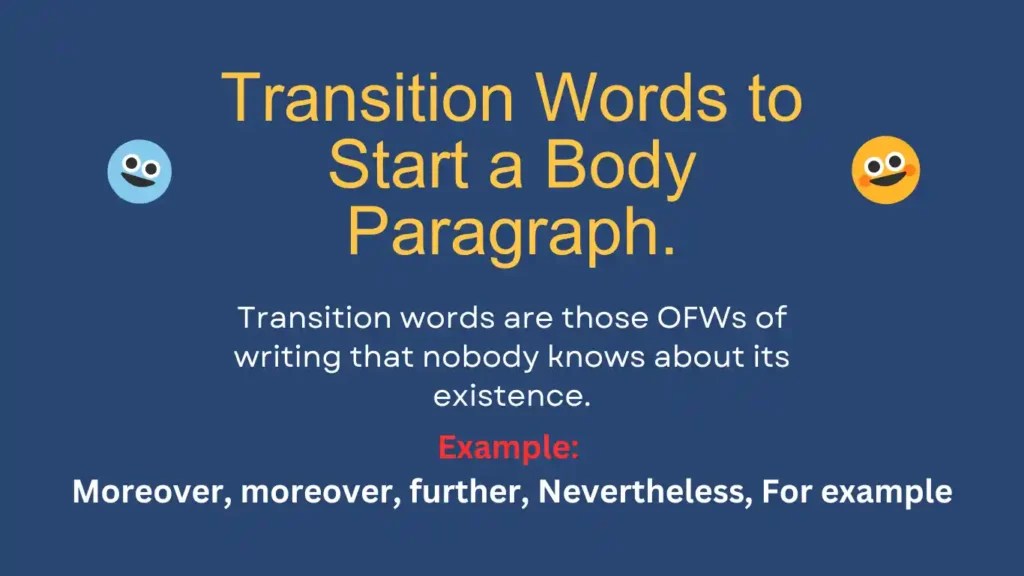
Achieving coherence in your body paragraphs means that all sentences and ideas within a single paragraph connect logically and flow smoothly. Each statement should build upon the last, creating a unified and easy-to-understand discussion. This seamless progression prevents your reader from getting lost or confused, ensuring your message is conveyed effectively. Using transition words and phrases between sentences and ideas within a paragraph is a powerful technique for enhancing this internal consistency, guiding the reader effortlessly from one point to the next.

Engagement goes hand in hand with coherence; a paragraph that holds a reader's attention often presents ideas in a clear and compelling manner. Varying sentence structure, using vivid language, and presenting arguments with conviction all contribute to making your paragraphs more captivating. Remember, even the most profound ideas can be overlooked if presented poorly. Therefore, consider your audience and strive to make your writing as accessible and interesting as possible, inviting them deeper into your analysis.

For writers targeting a US audience, clarity and directness are paramount. Long, convoluted sentences or paragraphs filled with jargon can deter readers. Focus on making your points explicit and supporting them with precise evidence. Crafting engaging paragraphs is not just about entertainment; it is about ensuring your important insights and arguments are fully grasped and appreciated. This attention to detail will significantly elevate the quality and impact of your written work, whether it is for an academic paper or a professional report.

How do you organize ideas within a body paragraph?

Organizing ideas within a body paragraph demands a systematic approach, often beginning with a clear topic sentence that introduces the paragraph's central idea. This sentence acts as a roadmap, telling the reader what specific point will be argued or explained. After the topic sentence, writers typically present their primary piece of evidence or supporting argument. This might be a statistic, a direct quote, a specific example, or an expert opinion that directly relates to the topic sentence.

Following the presentation of evidence, it is crucial to provide thorough analysis and explanation. This means breaking down the evidence, explaining its significance, and clarifying how it supports the topic sentence and, by extension, the essay's overall thesis. Do not assume your reader will automatically connect the dots; explicitly articulate those connections. This analytical component demonstrates your critical thinking and ensures the evidence is used effectively to build your argument.

To maintain coherence, writers then integrate further supporting details, examples, or elaboration. These secondary pieces of evidence or explanations should reinforce the main point without introducing entirely new ideas. Each sentence should flow logically from the previous one, often utilizing transitional phrases to ensure smooth movement. The paragraph often concludes with a summary sentence that reiterates the main point or provides a transition to the next body paragraph, ensuring a consistent and well-structured flow throughout the entire document.

Practical Tips for Developing Your Body Paragraphs

One of the most effective ways to develop stronger body paragraphs is to focus intensely on the quality and relevance of your evidence. Merely dropping quotes or statistics into your writing is not enough; you must select evidence that directly and powerfully supports your topic sentence. Before including any piece of data, ask yourself if it truly strengthens your argument or if it is merely tangential. High-quality, well-integrated evidence elevates your credibility and makes your arguments significantly more compelling.

Another vital tip is to thoroughly analyze your evidence. Many writers present evidence but fail to explain its significance fully. After introducing a piece of evidence, dedicate sufficient space to breaking it down: explain what it means, why it matters, and precisely how it proves your point. This analytical explanation is where you demonstrate your understanding and critical thinking, turning raw information into persuasive argument. Without this step, even compelling evidence can fall flat.

Finally, practice makes perfect. Writing and rewriting body paragraphs is the best way to refine your skills. Experiment with different organizational patterns, try out various transition words, and solicit feedback from peers or instructors. Pay close attention to paragraph unity, ensuring each paragraph focuses on a single, clear idea. Avoiding common pitfalls like paragraphs with too many ideas or those lacking sufficient evidence will significantly enhance the quality and impact of your overall writing. Continuously refining your approach ensures your paragraphs are consistently clear, coherent, and powerfully persuasive.

Summary

Understanding what constitutes a body paragraph is foundational for anyone aiming to write clearly and persuasively in academic or professional settings across the United States. These essential components of an essay or report are much more than just collections of sentences; they are meticulously constructed units designed to present and develop specific arguments that bolster the central thesis. Each body paragraph acts as a self-contained argument, beginning with a clear topic sentence that outlines its main idea, followed by robust supporting evidence, and concluded with insightful analysis that explains the evidence's significance.

Crafting effective body paragraphs demands attention to both coherence and engagement. Coherence ensures that all ideas within a paragraph flow logically and seamlessly, often aided by appropriate transition words and phrases. Engagement, meanwhile, stems from presenting these ideas with clarity, precision, and varied sentence structures, keeping the reader invested in your argument. Mastering these skills allows writers to build compelling narratives and persuasive analyses, ensuring their message is not only understood but also resonates deeply with the target audience.

Ultimately, a strong grasp of body paragraph structure and function is indispensable for achieving high-quality written communication. By focusing on strong topic sentences, relevant and compelling evidence, thorough analysis, and maintaining unity, writers can construct arguments that are both robust and easy to follow. This mastery is a continuous journey of practice and refinement, crucial for anyone looking to excel in writing and convey complex ideas effectively in the modern informational landscape of 2026 and beyond.

Understanding the core purpose and structure of a body paragraph is fundamental for effective writing across all academic and professional contexts in the United States a well constructed body paragraph serves as the backbone of any compelling essay or report clearly articulating individual arguments and supporting the overarching thesis statement This guide explores how to develop robust paragraphs from crafting an impactful topic sentence to integrating credible evidence and insightful analysis ensuring your writing achieves maximum clarity coherence and persuasive power for readers nationwide We delve into practical strategies for organizing your thoughts logically and connecting ideas smoothly allowing you to build a strong foundation for any written work whether for school university or business communications mastering body paragraphs is a crucial skill for anyone aiming to communicate effectively in English and make their message resonate with an American audience
body paragraph meaning,how to write a body paragraph,essay components,paragraph organization,academic essay structure,analytical writing,topic sentences,evidence in writing,conclusion sentence paragraph,effective communication writing

What is the main purpose of a body paragraph?

The main purpose of a body paragraph is to develop and support the essay's overall thesis statement by presenting a specific main idea, along with supporting evidence, examples, and analysis. Each body paragraph focuses on a single, distinct point, building a logical argument progressively. It ensures clarity and organization for the reader, making complex arguments manageable and persuasive for any US audience.

How many sentences are in a typical body paragraph?

A typical body paragraph does not have a fixed number of sentences, but it usually contains five to eight sentences. This allows for a topic sentence, several sentences of supporting evidence and explanation, and a concluding or transitional sentence. The actual length depends on the complexity of the idea being discussed and the amount of evidence required for full development.

What should a topic sentence do?

A topic sentence should clearly state the main idea or argument of its respective paragraph, acting as a mini-thesis for that section. It introduces what the paragraph will discuss, setting reader expectations and linking back directly to the overall essay thesis. An effective topic sentence provides focus and direction, ensuring paragraph unity and coherence for the reader.

Why is evidence important in a body paragraph?

Evidence is crucial in a body paragraph because it provides credible support and validation for the claims made in the topic sentence. Facts, statistics, examples, and expert opinions lend authority and persuasiveness to your arguments, moving beyond mere assertion. It helps convince the reader of the validity of your points, making your essay stronger and more reliable.

How does a body paragraph connect to the thesis statement?

A body paragraph connects to the thesis statement by systematically developing one specific aspect or argument that directly supports the broader claim presented in the thesis. Each paragraph's topic sentence should be a logical extension of the thesis. The content within the paragraph then provides evidence and analysis to substantiate that specific supporting point, collectively building a compelling case for the overall thesis.

What is paragraph unity and why is it important?

Paragraph unity means that all sentences within a single body paragraph contribute directly to its main idea, as stated in the topic sentence. Every piece of information, evidence, and analysis must be relevant and serve to develop that specific point. It is important because it ensures clarity, prevents confusion, and keeps the paragraph focused, making it easier for readers to follow your argument without distraction.

What role do transition words play in body paragraphs?

Transition words and phrases play a vital role in body paragraphs by creating smooth and logical connections between sentences and ideas. They guide the reader from one thought to the next, indicating relationships such as cause and effect, contrast, addition, or sequence. Effective transitions enhance paragraph coherence and ensure a natural, easy-to-follow flow for the entire essay.